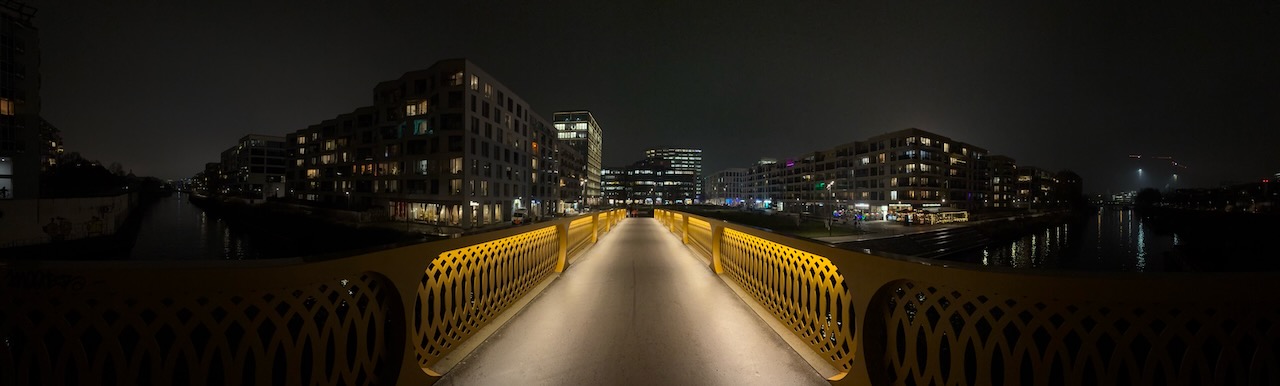


Otto-Weidt-Platz is one of the central hubs of Europacity – and at the same time, a symbol for many unresolved issues in the neighborhood: chaotic parking, a lack of shade, litter, and deficient infrastructure. To bring these grievances to light, a site inspection took place on November 14, 2025, alongside Member of the State Parliament (MdA) Silke Gebel and District Councilor Christoph Schriner.
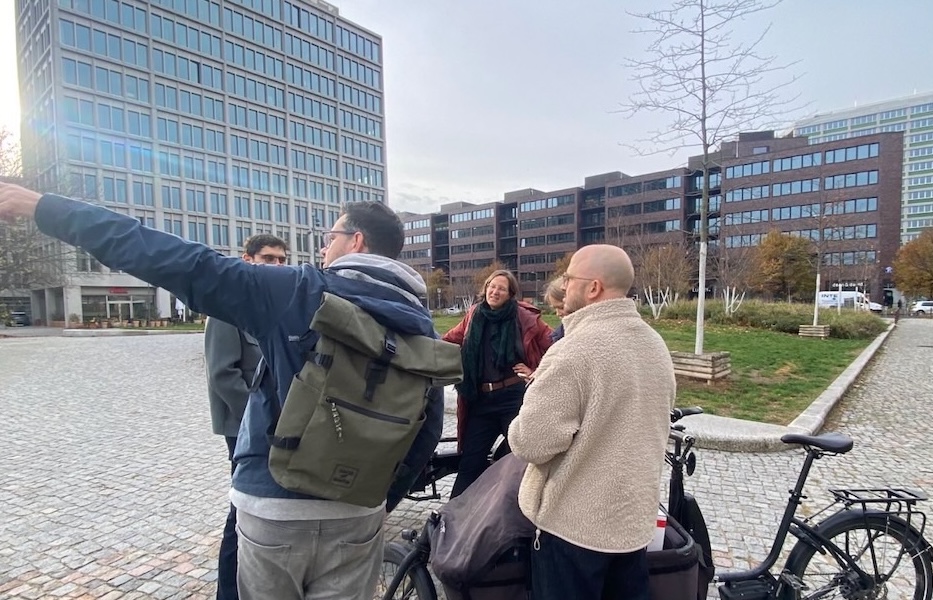
True to form, both arrived riding cargo bikes.
Shade by the Fountain
Passing by, we first talked about the fountain and how well it was received by local residents during the summer. However, as already mentioned here, what is sorely missing is shade around the fountain. In the summer, the stone benches are exposed to the blistering sun all day long.
We also discussed costs and the fact that many residents had donated trees as part of the City Tree Campaign (Stadtbaumkampagne). This would certainly be a viable option to fund additional greenery. Mr. Schriner pointed out that this might potentially run into issues regarding the architect's copyright. This remains to be clarified.
Illegal Parking as a Safety Risk
One of the biggest nuisances remains the situation with guests parking in front of the Casalot restaurant. When asked what the specific problem was, I recounted an incident involving an emergency medical vehicle that was unable to reach its destination by the waterfront, and pointed out that in the event of a fire, emergency services would be unable or delayed to reach the buildings on the square. This can cost lives.
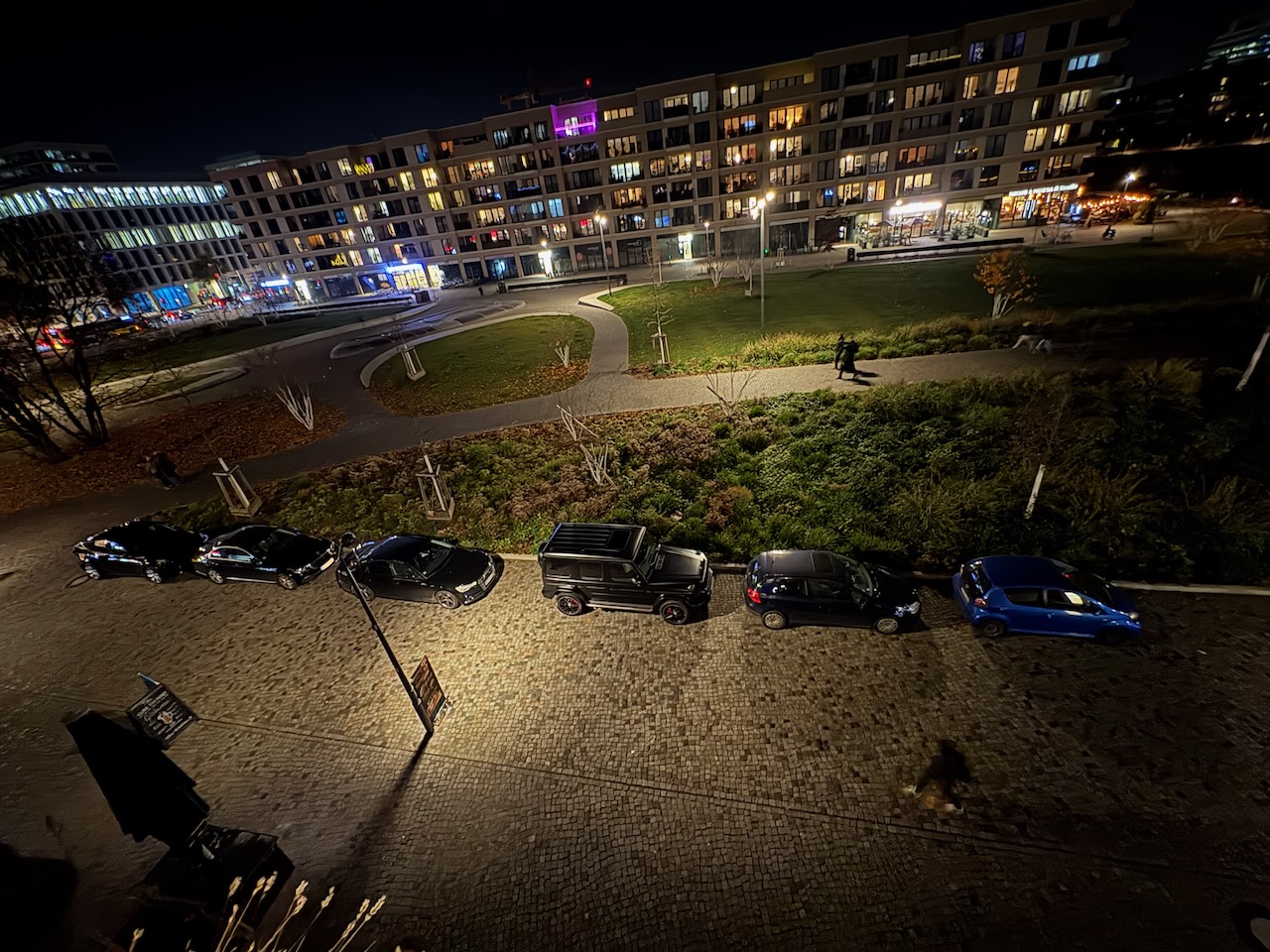
We then discussed various potential solutions.
Bollards
Since previous bollards were repeatedly removed by delivery vehicles, there seems to be a sense of resignation here. All kinds of smaller and larger vehicles easily squeeze past the single bollard that is still standing. One option would be to secure a bollard with a chain. However, someone would then have to be responsible for returning the bollard to its proper place every single time.
When I asked why retractable bollards could not be installed, Mr. Schriner explained that there is currently no city-wide concept or technical implementation in Berlin that allows emergency services to access and lower such bollards in an emergency. Consequently, these types of bollards are only found in very few locations across Berlin – and only where a gatekeeper or security guard is present 24/7.
We also noted that there is a 24-hour security guard present in the building of the Autobahn GmbH.
Reducing the Width
Mr. Schriner brought another idea into play: if the width of the pavement could be reduced so much that only a single vehicle could pass through, parking would become impossible. This could be achieved, for example, by setting up benches or by expanding the outdoor dining areas of local businesses facing the square.
Additional Signs
We asked why additional no-parking signs couldn't be installed. Mr. Schriner’s response was sobering. The existing signs (pedestrian zone) at the entrance already prohibit stopping and parking. The German Road Traffic Act (StVO) forbids adding another sign, as municipalities are urged to keep the number of traffic signs to an absolute minimum. If one sign implies another, the second one is not allowed to be put up.
Seeking a Dialogue with Casalot
Mr. Schriner promised to send an official letter to the operator of Casalot to inform them about the grievances and to prompt an improvement in the situation.
The Litter Situation
The open-air steps leading down to the water were very popular in the summer, but unfortunately, many pizza boxes were left behind. Why? Because the openings of the mounted trash cans are far too small. Some residents have already put up trash bags themselves. We wondered why the grey trash cans with larger openings, familiar from other parks in Berlin, couldn't be installed here.
The answer came promptly – and straight out of German bureaucratic hell. Otto-Weidt-Platz is officially not categorized as a park or green space, but rather as "street-side greenery" (Straßenbegleitgrün). In other words: a patch of lawn next to a street, just a little bit bigger. The Parks Department (Grünflächenamt) is responsible for green spaces, which means they can install different kinds of trash cans. However, street-side greenery falls under the jurisdiction of the BSR (Berlin's waste management utility) – and so do the trash cans. Nevertheless, they promised to look into whether improvements can be made.
Weekly Market
We have an immense amount of space on Otto-Weidt-Platz – so wouldn't it be wonderful to host a weekly market or perhaps even a Christmas market? This would attract residents from surrounding areas, support existing local restaurants, and potentially draw new businesses into the remaining vacant commercial spaces.
I had previously inquired about this with the Senate Department. The short version of their response was: not possible, as the market vehicles would damage the pavement blocks. This sounds like a mockery when you consider how many vehicles currently drive and park there unauthorized.
On a positive note, immediately after our meeting, Ms. Gebel contacted two market operators. One showed great interest and wanted to scout the area. The space behind the Hamburger Bahnhof museum would also be an option. She was also open to the idea of a Christmas market.
Playground
Next, we talked about a public playground. While the playgrounds in the inner courtyards of the residential blocks are great, they also lead to social isolation. Well-functioning squares in Berlin often feature a playground right in the center, surrounded by cafés and restaurants. The two officials could only confirm that further parks or green spaces are supposedly planned to the left and right of Heidestraße near the Kieler Brücke. Whether a playground is planned there – as previously stated by the Senate Department – they were unable to tell me.
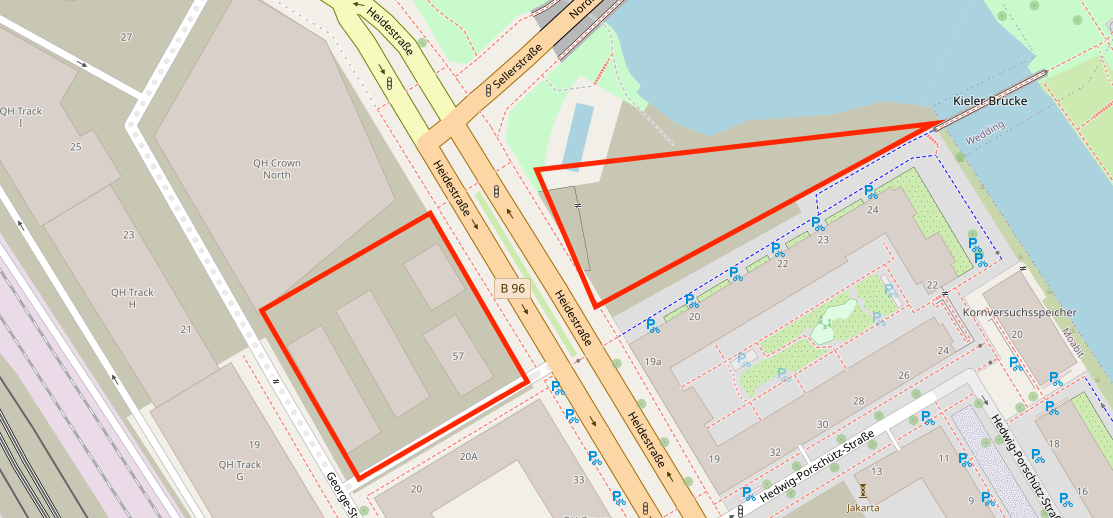
Additionally, the Döberitzer Grünzug is set to be developed along Minna-Cauer-Straße, offering sports facilities.
Connection to the Lehrter Kiez
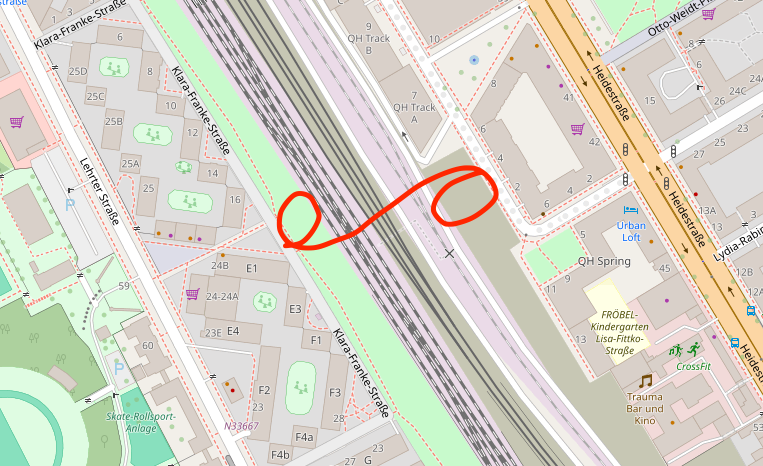
The long-planned bridge over the railway tracks, which would connect Europacity with Lehrter Straße, is now actually supposed to be built.
There is also a written inquiry regarding this matter from Ms. Gebel to the Senate, as well as a visualization from the Tagesspiegel.
Secondary Schools
Aside from the primary school at Nordhafen, which strictly speaking isn't really located inside Europacity, there are currently no secondary schools in the area. If you visualize all the schools on a map, you quickly realize that we live in a literal "void" without any schools within a radius of several kilometers. This was completely overlooked during the planning of Europacity – or planners relied on the fact that there is no legal entitlement to a short commute to secondary schools and gymnasiums.
To my surprise, however, an Integrated Secondary School (ISS) among other facilities is now slated to be built on the site of the former state laboratory (Landeslabor) on Invalidenstraße.
Culture: A Neighborhood Without Nightlife
Except for the Bata Bar, which is located on the premises of the future Bechstein Campus (and which, pleasingly, is not only staying but actually expanding), there is almost nothing here. No theaters, no other bars or pubs, no live music.
I suggested that potential operators might be deterred by the high commercial rents. Mr. Schriner responded by explaining that rent only accounts for a small fraction of the total running costs, with the vast majority going toward staffing costs. Ultimately, he believes it is just a matter of time, as many businesses are still waiting to see how the neighborhood develops.
Lack of Healthcare Services
When I asked which topics were particularly important to residents, I often heard that the area lacks even basic medical care, such as a general practitioner or a pharmacy.
Fundamentally, you cannot force anyone to open a business, and perhaps there are not (yet) enough patients or customers. However, considering the density of pharmacies in other neighborhoods, one can't help but wonder: why not here?
Since Ms. Gebel is also the Chair of the Committee for Health and Care, she wanted to take this issue on board and look into encouraging the establishment of a medical center in one of the many vacant office spaces.
Transport
When the Bus Simply Doesn’t Show Up Again
The current frequency (every 20 minutes) as well as the reliability of the only available public transport connection (Bus 147) leave much to be desired. Following the initial opening, the bus used to run at least every ten minutes.
Negotiations are currently underway with the BVG as part of the public tendering process. However, no further commitments were made.
Bike Paths
Anyone who has ever crossed the intersection at Sellerstraße by bicycle might recall the sheer thrill of it. The bike path runs between the traffic lanes here, causing cars to constantly cut across it. Unfortunately, the rule of the stronger wins out here.
Mr. Schriner explained that from today’s perspective, the original design of Heidestraße was flawed. It should have been built with a single lane for cars alongside a wide and protected bike lane.
Nevertheless, the existing bike path is scheduled to be color-coded (green for the bike path, red for hazard points).
Speed Cameras
We also discussed the fact that the speed camera on Heidestraße is actually in the wrong spot. Placing it directly by the square would make much more sense, as many residents cross the street there away from the traffic lights. Ms. Gebel subsequently submitted a minor inquiry to the Senate regarding this matter.
Safety on the Square
We drew attention to numerous break-ins – including in underground parking garages. Although it had escaped my notice until now, a mobile police station (mobile Wache) has allegedly been stationed at Otto-Weidt-Platz for some time.
Conclusion
Ms. Gebel and Mr. Schriner took nearly an hour and a half to look at everything and listen to our concerns – something I certainly hadn't expected. Mr. Schriner demonstrated an extensive wealth of expertise regarding both the legal situation and local conditions and planning, providing an answer to almost every question. I was also pleasantly surprised by how quickly Ms. Gebel took action immediately following our meeting.
It goes to show: if you want to change something, you have to take action yourself. There are people out there who listen – and who help.